1

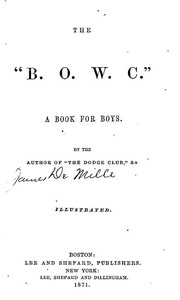
The "B. O. W. C.": A Book For Boys Illustrated — Background and Themes
(0 User reviews)
640
Project Gutenberg
2017
Not confirmed
Schools -- Juvenile fiction; Adventure stories; Camping -- Juvenile fiction; Sailing -- Juvenile fiction; Voyages and travels -- Juvenile fiction; Survival skills -- Juvenile fiction; Boarding school students -- Juvenile fiction; Cooperativeness -- Juvenile fiction; Grand Pré (N.S.) -- Juvenile fiction
Readers of public-domain and historical texts
Project Gutenberg digital edition
en
Edition facts
Words
74,030
Reading time
322 min
Text sections
10
The "B. O. W. C.": A Book For Boys Illustrated — Background and Themes can be approached with a clearer sense of reading commitment from its source measurements: 74,030 words, 5 hr 22 min estimated reading time, and 10 detected text sections.
The text analysis averages about 13.1 words per sentence, while the detected sections provide another way to judge how the source is divided.
Project Gutenberg metadata also associates the work with “Schools -- Juvenile fiction,” connecting these edition facts with the source record’s subject description.
Source:
Project Gutenberg record #56231
This editorial note examines the structure and recurring images in James De Mille's 'B. O. W. C.', focusing on the movement between scenes, the use of fog and tides, and the character of Pat as a comic and earnest figure.
Read the complete public-domain text at its original source.
Read on Project GutenbergFrom its opening chapters, The "B. O. W. C." establishes a pattern of movement between scenes that is both literal and thematic. The narrative shifts rapidly from the school at Grand Pré to the shores of Minas Basin, then to a desert island, and back again, often propelled by the region's formidable tides and fogs. This restless progression is mirrored in the chapter titles, which promise a sequence of "astonishing processions," "eccentric crews," and "hazardous adventures." The structure itself becomes a kind of voyage, with each chapter ending on a note of anticipation or crisis.
The Rhythm of Departure and Return
The book's structure is built around a series of departures and returns. The boys set out from Grand Pré School, encounter mishaps, and periodically return to familiar ground—only to set out again. This pattern is evident in the chapter sequence: after being lost in the fog, they wash ashore on a lonely beach, build a shelter, and then resume their travels. The return to Pratt's Cove in Chapter XI is not an ending but a prelude to further adventures. The rhythm gives the narrative a cyclical quality, where each new departure carries the memory of previous ordeals.
Fog and Tide as Structural Forces
Fog and tide are not merely atmospheric details but structural forces that dictate the plot's movement. The fog in Chapter VI "Lost in the Fog" strands the boys, forcing them to improvise. The tide, described as "running out" and "running in," governs their ability to travel and find food. These natural elements create a sense of vulnerability and urgency, pushing the characters from one scene to the next. The foghorn blast and the search amid mists become recurring motifs, emphasizing how the environment shapes the narrative's pace and direction.
Pat: The Comic and Earnest Outsider
Among the boys, Pat stands out as a character who embodies both comedy and earnestness. His "taste of the brogue" and his ignorance of the trip's scientific purpose provide humor, but his backstory—begging for admission to the school, working his way, and showing "exceedingly strong desire to be taught more"—adds depth. His frustration with finding only stones in the mineral baskets, and his indignation at a bare ham-bone, are comic moments that also reveal his practical, survival-oriented mindset. Pat's presence introduces a class dimension and a different kind of intelligence into the group.
Recurring Images of Food and Frustration
Food—or the lack of it—appears repeatedly as a source of both comedy and tension. The boys' attempts at cookery are consistently thwarted: Pat flings a bare ham-bone into the water, they "scratch for clams" with disastrous results, and a "formidable medicine chest" is consulted after folly. These episodes are not just filler; they underscore the gap between the boys' expectations of adventure and the gritty reality of survival. The repeated failure to secure a meal becomes a running gag that also highlights their resourcefulness—or lack thereof—and their growing desperation.
Readers approaching The "B. O. W. C." will find that its pleasures lie less in a tightly plotted arc than in the accumulation of small, vivid episodes. Pay attention to the way De Mille uses the landscape—the tides, the fog, the rocky shores—as both obstacle and catalyst. The boys' repeated failures and recoveries create a rhythm that is more picaresque than linear, and Pat's distinctive voice offers a counterpoint to the more earnest members of the club.
Decades shelving these tales, I notice how De Mille’s boys drift through fog toward each new tide, always half-lost yet wholly earnest. That same unhurried trust in chance guides another young traveler, whose cockpit hums above a different coast. There’s a kinship in their quiet faith that maps mislead less than patience. Linda Carlton's Hollywood Flight — Inside the Classic holds that identical warmth.
There are no reviews for this eBook.
There are no comments for this eBook.
Reader reflection
What was your reading experience?
Capture what you thought, learned, and would like to remember.
Your progress
0
/
10
2
What was your overall reaction to the book?
3
How likely are you to recommend this book?
4
How demanding did the text feel?
5
How did the pace of the book feel?
6
Would you read this book again?
7
Which part made the strongest impression?
8
How useful were the ideas in this book?
9
What changed or sharpened your thinking?
10