1

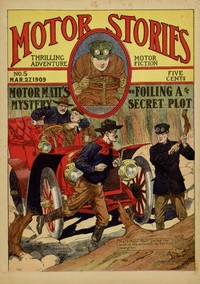
Motor Matt's Mystery; or, Foiling a Secret Plot — Text and Context
(0 User reviews)
659
Project Gutenberg
2014
Not confirmed
Adventure stories; Automobiles -- Juvenile fiction; Dime novels; Jewel thieves -- Juvenile fiction; Mechanics -- Juvenile fiction
Readers of public-domain and historical texts
Project Gutenberg digital edition
en
Edition facts
Words
35,675
Reading time
156 min
Text sections
4
Before opening Motor Matt's Mystery; or, Foiling a Secret Plot — Text and Context, the edition data offers a quick orientation: 35,675 words, 2 hr 36 min estimated reading time, and 4 detected text sections.
The text analysis averages about 14.0 words per sentence, while the detected sections provide another way to judge how the source is divided.
Project Gutenberg metadata also associates the work with “Adventure stories,” connecting these edition facts with the source record’s subject description.
Source:
Project Gutenberg record #47179
This editorial note examines Stanley R. Matthews' 1909 dime novel through its diction, dialogue, and description, focusing on the German-accented speech of Carl Pretzel, the mechanical precision of Motor Matt, and the rapid, action-driven prose style typical of early motor fiction.
Read the complete public-domain text at its original source.
Read on Project GutenbergFrom its first page, Motor Matt's Mystery; or, Foiling a Secret Plot announces itself through sound: “Whiz, bang!” and a cascade of broken English from Carl Pretzel, the German sidekick. The opening chapter drops the reader into a chaotic fight between Carl and a Chinese laundryman, Hop Loo, whose pidgin speech (“Dutchee boy no good! Have gotee mon, no makee pay”) contrasts sharply with Carl’s thick dialect (“Py shiminy grickets”). This collision of voices, rendered in phonetic spelling and exclamation points, establishes the dime novel’s reliance on broad comic types and rapid-fire action. The author, Stanley R. Matthews, wastes no time on scene-setting; the narrative plunges into conflict, a hallmark of the weekly serial format.
Dialect as Characterization
Carl Pretzel’s speech is the most distinctive feature of the prose. Matthews renders his German accent through consistent misspellings and grammatical shifts: “vat” for “what,” “der” for “the,” “peen” for “been,” and “hafen’t” for “haven’t.” Exclamations like “Py shiminy grickets” and “Wienerwurst, hey?” mark Carl as a comic figure, but his dialogue also drives plot—his outbursts often signal danger or discovery. In contrast, Motor Matt speaks in clean, standard English, reinforcing his role as the capable hero. The Chinese characters, Hop Loo and Charley Sing, speak in a different pidgin (“Allee same cheap skate”), reflecting period stereotypes. Matthews uses these linguistic shortcuts to quickly establish character types without lengthy description.
Mechanical Precision in Description
When Motor Matt interacts with automobiles, the prose becomes precise and technical. Matt “bent to the crank” of the car, and the engine “poppety-pop” splutters to life. The car is called the “Red Flier,” and its movements are described with mechanical specificity: “slid into his seat,” “jumped to the high gear,” “covering the back trail.” This vocabulary—chassis, tonneau, foot-board, tail lamp—grounds the adventure in the emerging technology of the early 1900s. Matthews avoids vague action verbs; instead, Matt “started the car” and “halted the car,” showing a methodical approach. The author’s familiarity with automobile parts suggests an intended audience of boys fascinated by machines, and the descriptions serve both to educate and to heighten tension during chase scenes.
Action-Driven Prose and Sentence Rhythm
Matthews favors short, punchy sentences and frequent paragraph breaks to create a breathless pace. In the escape scene, sentences are clipped: “Then away they went, covering the back trail as rapidly as they had gone over it the other way.” Action verbs dominate: “plunged,” “slammed,” “dragged,” “sprang.” The narrative often shifts abruptly between external action and internal reaction, as when Matt feels “a thrill of disappointment” while simultaneously driving. The author uses sound effects (“Whiz, bang, clatter, bang!”) and onomatopoeia (“Poppety-pop”) to mimic the sensory experience of a chase. This style, typical of dime novels, prioritizes momentum over introspection, keeping the reader engaged from one chapter to the next.
The Role of Physical Comedy
Physical violence in the novel is often played for laughs, especially in scenes involving Carl. When he fights Pringle in the tonneau, the description is a catalogue of thumps and exclamations: “Thump, smack, bang! went Carl’s fists.” The car “rocked from side to side” under the struggle, blending mechanical and bodily motion. Carl’s dialogue during the fight—“I make you t’ink it tifferent, you lopster!”—turns the altercation into a comic routine. Matthews balances this with Matt’s sober interventions: “That’ll do, Carl!” he cries, grabbing the Dutch boy by the collar. The juxtaposition of Carl’s slapstick and Matt’s seriousness defines their partnership: one provides muscle and humor, the other control and direction.
Readers approaching Motor Matt's Mystery should listen for the voices. The dialect work, while dated, is the book’s most energetic feature, and the mechanical details reward attention to how Matt handles his car. The story moves fast—too fast for deep character development—but the author’s choices in diction and rhythm create a distinctive, pulpy texture. Treat the excerpts as a sample of early twentieth-century serial fiction, where every line is engineered to keep the wheels turning.
I found myself slowing down over the German-accented cadences of Carl Pretzel in Motor Matt's Mystery, the way his words bent around the mechanics of the swift prose. It reminded me, strangely, of a quieter set of reading notes—not the action, but the lingering echo of a voice shaped by place and pacing. Copper Coleson's Ghost — Reading Notes felt like that same warm afterglow, without the engines.
There are no reviews for this eBook.
There are no comments for this eBook.
Reader reflection
Your personal reading reflection
Build a private reading journal entry for this title.
Your progress
0
/
10
2
What was your overall reaction to the book?
3
How likely are you to recommend this book?
4
How much effort did this book require?
5
Did any part of the book stay with you emotionally?
6
Could you see yourself revisiting this book?
7
How clearly were the main ideas presented?
8
Could you apply anything you learned?
9
What did this book teach you most?
10