1

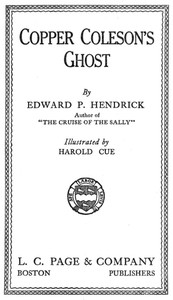
Copper Coleson's Ghost — Reading Notes
(0 User reviews)
64
Project Gutenberg
2014
Not confirmed
Ghost stories; Adventure stories; Boys -- Juvenile fiction; Mystery and detective stories; Smuggling -- Juvenile fiction; Smugglers -- Juvenile fiction; Haunted houses -- Juvenile fiction; Apparitions -- Juvenile fiction; Mining camps -- Juvenile fiction
Readers of public-domain and historical texts
Project Gutenberg digital edition
en
Edition facts
Words
47,812
Reading time
208 min
Text sections
7
Copper Coleson's Ghost — Reading Notes can be approached with a clearer sense of reading commitment from its source measurements: 47,812 words, 3 hr 28 min estimated reading time, and 7 detected text sections.
The text analysis averages about 16.7 words per sentence, while the detected sections provide another way to judge how the source is divided.
Project Gutenberg metadata also associates the work with “Ghost stories,” connecting these edition facts with the source record’s subject description.
Source:
Project Gutenberg record #47633
Edward P. Hendrick's 1930 boys' adventure blends ghost lore, smuggling, and mining-camp mystery in Truesdell. The narrative shifts between athletic banter, tense nocturnal stakeouts, and rapid chase sequences, with a skeptical sidekick whose voice undercuts the supernatural premise.
Read the complete public-domain text at its original source.
Read on Project GutenbergThe opening chapter of Copper Coleson's Ghost establishes a leisurely, sun-drenched summer atmosphere through Ned Blake's rope-climbing and banter with his friend Tommy Beals. The prose lingers on physical detail—Ned's “sleeveless jersey, duck trousers and sneakers,” the apple tree's history—before the mystery intrudes. By Chapter XV, the tone has tightened: the boys move in whispers, Ned drops to his knees at a clearing, and the flivver's “coughing” engine punctuates a landscape of “broken twigs and stripped leaves.” This shift from casual gymnasium scenes to cautious woodland reconnaissance marks a deliberate change in pace, as the narrative exchanges open dialogue for hushed signals and long minutes of stillness.
Voice and Skepticism in Dialogue
The dialogue carries much of the story's character work. Tommy's “Bully stuff!” and Ned's teasing “Fatty” establish a friendly, competitive rapport. But the most distinctive voice belongs to Dave Wilbur, whose drawled skepticism—“‘Too many cooks spoil the broth’”—and refusal to join the search create a counterpoint to the group's growing unease. When Charlie Rogers “glared angrily at the scoffer,” the exchange reveals tension between belief and mockery. Wilbur's role as the skeptic is not merely comic; his lounging posture and “irritating chuckle” provide a narrative brake on the ghost premise, forcing the other boys to justify their actions. The text does not confirm whether the ghost is real, but Wilbur's persistent doubt keeps the reader from fully committing to the supernatural.
Pacing Through Physical Description
Hendrick controls tension by alternating rapid action with patient observation. In the early chapters, movement is brisk: Ned descends from the tree “in a veritable cascade of cat-skinning, toe-holding, ape-like swings.” Later, the pace slows to a crawl as the boys “threaded the grass-grown track” for two miles, noting “broken twigs and stripped leaves.” The description of the shack—its “rough table of slabs” and “rusty stove propped up with bricks”—is delivered in flat, inventory-like prose that contrasts with the earlier athletic energy. This deliberate deceleration mirrors the boys' own caution: they stop talking, drop to whispers, and lie motionless for ten minutes. The reader experiences the same waiting as the characters.
Recurring Details and Setting
Several small details recur and accumulate meaning. The flivver appears first as a patient vehicle, then as a potential target of the “humpbacked spook.” The old wood-road is described twice: once as a path the boys stumbled onto, later as a route marked by “rubber tires” and overgrowth. The clearing with slab piles and a shanty is introduced as a wood-cutters' camp, but its emptiness feels ominous. These repeated elements—the car, the road, the shack—anchor the mystery in physical space. The text does not reveal what the boys find inside the shack beyond its bunks and stove, but the act of pushing open the door and stepping in shifts the story from outdoor adventure to enclosed, uncertain territory.
Readers should attend to how Hendrick uses the flivver as both transport and comic prop, and to the way the boys' nicknames—Red, Fatty, Weary—signal group dynamics that shift under pressure. The excerpts offer no resolution to the ghost question, but the careful layering of physical evidence (tire marks, broken twigs) against Wilbur's mockery suggests that the mystery may have a material explanation. The narrative rewards attention to what is seen versus what is said.
There’s something about the way Hendrick lets his skeptic talk you out of the ghost story, then pulls you back in when the dark closes in—it reminds me of the quieter moments in Out with Garibaldi: A story of the liberation of Italy — Edition Insights, where doubt and courage keep trading places. Both feel like old friends whispering at a campfire.
There are no reviews for this eBook.
There are no comments for this eBook.
Reader reflection
Your personal reading reflection
Build a private reading journal entry for this title.
Your progress
0
/
10
2
Was reading this book enjoyable?
3
Would you encourage someone else to read it?
4
How easy was the book to follow?
5
How closely did the book connect with your experience?
6
How distinctive were its ideas or approach?
7
Would a second reading be valuable?
8
How valuable was this book for your own interests?
9
Which lesson or insight stayed with you?
10