1

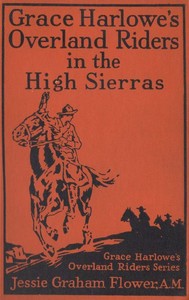
Grace Harlowe's Overland Riders in the High Sierras — Key Ideas to Explore
(0 User reviews)
461
Project Gutenberg
2014
Not confirmed
Western stories; Adventure stories; Vacations -- Juvenile fiction; Brigands and robbers -- Juvenile fiction; Cowgirls -- Juvenile fiction; Firearms -- Juvenile fiction; Sierra Nevada (Calif. and Nev.) -- Description and travel -- Juvenile fiction
Readers of public-domain and historical texts
Project Gutenberg digital edition
en
Edition facts
Words
53,670
Reading time
234 min
Text sections
24
For Grace Harlowe's Overland Riders in the High Sierras — Key Ideas to Explore, the stored edition analysis reports 53,670 words, 3 hr 54 min estimated reading time, and 24 detected text sections.
The text analysis averages about 14.1 words per sentence, while the detected sections provide another way to judge how the source is divided.
Project Gutenberg metadata also associates the work with “Western stories,” connecting these edition facts with the source record’s subject description.
Source:
Project Gutenberg record #45989
This editorial note examines how Grace Harlowe's Overland Riders in the High Sierras uses episodic structure, recurring images of food and sleep, and movement between train, camp, and canyon to build a serial adventure.
Read the complete public-domain text at its original source.
Read on Project GutenbergFrom the opening chapter, Grace Harlowe’s Overland Riders in the High Sierras establishes a pattern of abrupt transitions. The first scene—a train hold-up—gives way to a chase, then a camp, then a lost trail, each shift signaled by a chapter break and a new crisis. The narrative moves not by gradual development but by a series of jolts: a scream, a shot, a discovery. This episodic rhythm, common in serial fiction, keeps the action immediate but also creates a sense of constant motion, as if the story itself is traveling.
Structure as a Series of Setbacks
The book’s twenty-four chapters each pivot on a fresh difficulty. Chapter I ends with “Shots and yells”; Chapter II with a train stopping abruptly; Chapter III with a call for volunteers. The pattern repeats: the Overlanders plan, encounter trouble, react, and move on. In Chapter XII, the group searches for water, Tom Gray gets lost, and the chapter closes with them sleeping under sequoias. Chapter XIII opens with Stacy waking and Tom’s return—but no water found. The structure does not allow for prolonged relief; each solution is partial, each success temporary. This keeps the reader oriented toward the next obstacle rather than the journey’s end.
Recurring Images: Food, Sleep, and the Body
Two motifs recur with notable frequency: food and sleep. Stacy Brown, nicknamed “Chunky,” is almost always hungry or eating. In Chapter V he helps himself to a plum pudding; in Chapter VIII he complains “I want food!”; in Chapter XII he prepares his bed by smoothing ground with an axe, then falls asleep immediately. Sleep, too, punctuates the action—often as a sudden drop, as when “all at once, it was morning” after a tense night. These bodily needs ground the adventure in physical reality, contrasting with the high drama of bandits and lost trails. They also serve as comic relief, especially through Stacy’s antics.
Movement Between Settings: Train, Camp, Canyon
The story moves through three distinct settings: the transcontinental train (Chapters I–VII), the forest camp (Chapters VIII–XII), and the canyon (Chapter XIII onward). Each setting imposes its own rules. On the train, the threat is bandits and the response is organized defense. In camp, the dangers are internal—lost supplies, rattlesnakes, lost companions. The canyon introduces vertical space: the trail “pitched giddily into a deep canyon” and climbing becomes the central challenge. This shift from horizontal travel (train) to stationary camp to vertical descent changes the pace and the kind of problem-solving required.
Voice and Dialogue: Chunky’s Boasts and Woo’s Pidgin
Two characters stand out for their distinctive speech. Stacy Brown boasts in a comic register: “I suppose I emptied twelve saddles” (Chapter VI) and “My pony can climb a tree” (Chapter VIII). His bravado is undercut by his incompetence. Woo Smith, the Chinese cook, speaks in a simplified pidgin: “Woo no lost. Tlail him lost” and “Me savvy somebody pull queue.” This dialect marks him as an outsider and a source of humor, but also as a practical helper. The contrast between Chunky’s inflated claims and Woo’s terse, often accurate observations creates a running tension between appearance and reality.
Readers approaching this book will find a fast-moving adventure built on repeated patterns: a crisis, a response, a brief pause, then the next crisis. Pay attention to how the setting changes—from train to camp to canyon—and how each shift alters the group’s dynamics. The recurring focus on food and sleep may seem trivial, but it anchors the story in the characters’ physical experience. The dialogue, especially Stacy’s boasts and Woo’s pidgin, reveals much about the social hierarchy of the group.
There’s something about a journey where hunger and rest mark the hours—like Grace Harlowe’s mountain trail, where a meal feels like a small triumph. I kept thinking of that tenderness while revisiting Fighting Joe; Or, The Fortunes of a Staff Officer. A Story of the Great Rebellion — Reading Companion, where movement between camps carries the same quiet weight of survival and waiting. Both linger, softly.
There are no reviews for this eBook.
There are no comments for this eBook.
Reader reflection
Take a moment to reflect on this book
Create a short personal record of your experience with this book.
Your progress
0
/
10
2
Was reading this book enjoyable?
3
Is this a title you would suggest to others?
4
How demanding did the text feel?
5
Could you follow the author’s main argument?
6
Did the book give you something worth debating?
7
Was the book moving at the right speed?
8
How well did it match your expectations?
9
What changed or sharpened your thinking?
10