1

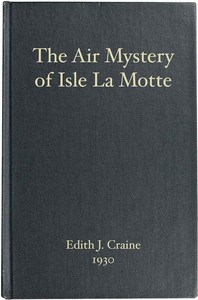
The Air Mystery of Isle La Motte — A Reader’s Guide
(0 User reviews)
871
Project Gutenberg
2014
Not confirmed
Adventure stories; Air pilots -- Juvenile fiction; Mystery fiction; Smugglers -- Juvenile fiction; Airplanes -- Juvenile fiction; Royal Canadian Mounted Police -- Juvenile fiction; Stepbrothers -- Juvenile fiction
Readers of public-domain and historical texts
Project Gutenberg digital edition
en
Edition facts
Words
47,497
Reading time
207 min
Text sections
13
For The Air Mystery of Isle La Motte — A Reader’s Guide, the stored edition analysis reports 47,497 words, 3 hr 27 min estimated reading time, and 13 detected text sections.
The text analysis averages about 15.8 words per sentence, while the detected sections provide another way to judge how the source is divided.
Project Gutenberg metadata also associates the work with “Adventure stories,” connecting these edition facts with the source record’s subject description.
Source:
Project Gutenberg record #45549
The opening of E. J. Craine's 1930 adventure introduces step-brothers Jim and Bob, whose plane 'Her Highness' lands them in a tense encounter with a Mountie. The excerpt shows their Texan drawl, quick wit, and the immediate suspicion of smuggling, setting up a mystery involving a truck driver named Pedro and a forced landing on a narrow road.
Read the complete public-domain text at its original source.
Read on Project GutenbergThe first chapter of The Air Mystery of Isle La Motte opens with a Mounted Policeman confronting two boys who have just landed their plane in Quebec. Jim Austin, age sixteen, and his step-brother Bob Caldwell, fifteen, answer with a drawl that marks them as Texans. The Mountie is suspicious—smuggling and illegal immigration are rife—and the boys' casual demeanor does little to reassure him. The dialogue is brisk and laced with humor: Jim asks if the horse is real, and Bob offers to "fork you on something superior." This initial encounter establishes the story's tone: a blend of aerial adventure, lighthearted banter, and a persistent undercurrent of danger.
A Mountie’s Suspicion and a Texan’s Drawl
The opening pages introduce the central conflict through a single, charged scene. The Mountie demands the truth, and Jim replies, "You want the truth, the whole truth, and nothing but the truth?"—a line that echoes a courtroom oath but is delivered with a grin. The boys' age and appearance are noted: "both had tow heads, and they didn’t look at all formidable." Yet the officer is not fooled; he knows that "a couple of perfectly innocent looking youths might be the tools or employees of some powerful gang." This early tension—between appearance and reality—is a key motif. The excerpt also reveals that the boys are step-brothers, a detail that may shape their dynamic. The Mountie’s suspicion of the airplane itself—"The fact that they dropped out of the skies in an airplane was in itself suspicious"—grounds the mystery in the technology of the era.
A Forced Landing and a Hostile Truck Driver
Later in the excerpt, the boys are forced to land on a narrow road, blocking a truck driven by a man named Pedro. The scene shifts from official suspicion to direct confrontation. Pedro curses and threatens: "You be out of here by the time I get my engine started, or I send you both to hell." The boys respond with sarcasm—"Thanks a lot, Old Timer. Every little favor is greatly appreciated"—and feign mechanical trouble to delay him. The plane’s engine "coughed apologetically," a personification that adds a touch of humor. The road is described as curving sharply with no room to spare, heightening the physical danger. Pedro’s anger and the boys’ deliberate stalling suggest that the truck may be carrying something illicit, though the excerpt does not confirm this. The dialogue is sharp and fast-paced, with the boys trading quips while the threat of violence looms.
Voice and Structure: Dialogue-Driven Action
Craine’s prose relies heavily on dialogue to advance the plot and reveal character. The Mountie speaks in clipped, official tones; the boys use a colloquial, teasing register. Bob’s line "Stick your tongue out at him" and Jim’s retort "I’d rather punch his jaw" show their bravado. The narrative is interspersed with brief physical descriptions—"the blue-eyed youth," "the grey-eyed boy"—but the focus remains on what is said. The structure of the opening chapter is simple: a single extended encounter, followed by a second confrontation. This pattern suggests that the mystery will unfold through a series of tense, dialogue-heavy scenes. The airplane, named "Her Highness," is treated almost as a character; the boys coax and scold it. Readers should pay attention to how the boys use language to deflect suspicion and buy time.
Setting the Stage for Aerial Mystery
The setting is established through specific details: the southern part of Quebec, a Mountie on horseback, a road that curves sharply, and a plane with floats. The mention of smuggling and illegal immigration places the story in a real-world context of border enforcement. The boys’ origin in Texas is emphasized through their accent and references to Cap Rock and a pinto horse. This regional contrast—Texans in Canada—adds a layer of cultural friction. The excerpt does not reveal what the mystery is, but it plants clues: the Mountie’s suspicion, Pedro’s anger, and the boys’ deliberate interference. The title mentions Isle La Motte, a real island in Lake Champlain, but the excerpt does not yet take the characters there. Readers should note the repeated emphasis on observation—the boys spotted the Mountie from 3,000 feet—and the theme of things not being what they seem.
The excerpts offer a vivid introduction to the story’s tone and method: rapid-fire dialogue, a pair of resourceful protagonists, and a mystery rooted in the landscape and technology of 1930. Readers will benefit from paying close attention to how the boys use humor as a shield and how the setting—Quebec’s roads and skies—shapes the action. The incomplete nature of the excerpts means that the central puzzle remains hidden, but the groundwork is laid for an adventure that blends aerial thrills with the cat-and-mouse game of detection.
There’s something about Jim and Bob’s forced landing that keeps tugging at me—that helpless engine, the narrow road hemmed in by trees. It reminded me, quietly, of another vanished figure I once followed: Hal Kenyon, slipping away between one page and the next. Both feel like summer afternoons that turned secret. Hal Kenyon Disappears — A Reader’s Guide stays with me the same way.
There are no reviews for this eBook.
There are no comments for this eBook.
Reader reflection
Before you leave, reflect on the book
Use these questions to collect your thoughts before moving on.
Your progress
0
/
10
2
Did this book hold your interest?
3
Would you encourage someone else to read it?
4
How demanding did the text feel?
5
What did you think about the pace?
6
How would you rate its originality?
7
How useful did the reading feel?
8
How closely did the book connect with your experience?
9
What changed or sharpened your thinking?
10