About 175 minutes
The Brownie Scouts at Snow Valley — Text and Context
Childrens Adventures
40,146 recorded words. 1 minutes difference from this book's estimate.
View Gutenberg source #51744
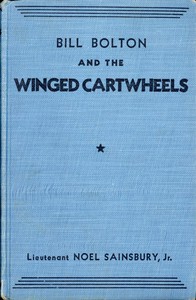
This digital edition of Bill Bolton and the Winged Cartwheels — Reading Notes is described by source-level measurements including 40,330 words, 2 hr 56 min estimated reading time, and 6 detected text sections.
The text analysis averages about 13.5 words per sentence, while the detected sections provide another way to judge how the source is divided.
Project Gutenberg metadata also associates the work with “Air pilots -- Juvenile fiction,” connecting these edition facts with the source record’s subject description.
Explore this collection
These alternatives are selected using recorded categories and estimated reading time.
About 175 minutes
Childrens Adventures
40,146 recorded words. 1 minutes difference from this book's estimate.
View Gutenberg source #51744About 175 minutes
Childrens Adventures
40,106 recorded words. 1 minutes difference from this book's estimate.
View Gutenberg source #55243About 185 minutes
Childrens Adventures
42,440 recorded words. 9 minutes difference from this book's estimate.
View Gutenberg source #49643Search stored excerpts and compare books → Choose by your preferences →
Choices use stored catalog measurements. Estimates vary with reading speed. A shared category is a catalog label, not a claim that two books have the same argument or literary quality.
Search reads excerpt text stored with this catalog and links to its associated Gutenberg record. The connection is stored in the site database; this tool does not recheck that every excerpt is word-for-word identical to that external record. Excerpt search does not cover every chapter and does not verify historical publication dates.
Catalog snapshot checked: 2026-09-25. Coverage: 91 public books, 91 available source excerpts.
Read the complete public-domain text at its original source.
Read on Project GutenbergNoel Sainsbury Jr. opens Bill Bolton and the Winged Cartwheels with a defaced silver dollar—a coin bearing die-cut wings over Liberty’s face and the numerals 1 and 3. This object, found in the grass of a Connecticut driveway, immediately signals a mystery rooted in aviation and coded markings. The author’s choice to begin with a tangible clue rather than a chase or a villain’s introduction establishes a puzzle-driven narrative. The coin’s description is precise: the eagle is “defaced,” the wings are “cut deep into the metal.” Sainsbury does not explain the symbol; he lets the characters—Bill and Osceola—speculate, using terms like “cloud-dodger’s mascot” and “lucky number.” This restraint in exposition invites the reader to share the protagonists’ curiosity.
Osceola, the Seminole chief, speaks in a distinctive vernacular that Sainsbury uses to mark his background without reducing him to stereotype. His opening line—“You and I, Bill, are on top of the world and throwing rocks at rainbows!”—combines colloquial energy with a poetic image. Later, he says, “Nobody ever hurled dollar bills at me!” The verb “hurled” and the phrase “cramp your usual technic” (Bill’s reply) show a playful, self-aware register. Sainsbury also gives Osceola moments of formal clarity: “Instead of having to work my way through my last year at Carlisle, your father puts me in charge of the foundation.” The contrast between his casual exclamations and his precise statements about his circumstances suggests a character who code-switches, a detail that adds depth beyond the adventure plot.
The defaced silver dollar is more than a plot token; Sainsbury uses it to establish a pattern of observation and deduction. Bill examines the coin methodically: “The coin seemed genuine enough. Minted in 1897, the head of Liberty was portrayed on one side and backed by the well-known National Bird.” The description is almost clinical, yet the defacement—wings across Liberty’s face—introduces an unsettling visual. The numerals 1 and 3 are “diecut,” a term that implies deliberate craftsmanship. By having the characters debate whether it is a “pocket-piece” or a “mascot,” Sainsbury trains the reader to attend to small details. The coin reappears later as a clue linked to a “much bigger racket,” fulfilling its early promise without overexplanation.
When Mr. Davis, the secret service agent, arrives, Sainsbury introduces him through dialogue rather than description. Davis says, “I had known for a week or so that you’d been taken on by the Department, and so I requested your services on the job.” The line is matter-of-fact, almost bureaucratic, yet it reveals that Bill is already an operative. The author avoids dramatic reveals; instead, he lets the reader infer the scope of the operation from casual references to “Washington on the wire” and “free rein.” Davis’s request for Osceola’s help is similarly low-key: “I’ve been authorized to secure Chief Osceola’s services on this case.” This restrained handling of institutional authority keeps the focus on the characters’ relationships rather than on the machinery of government.
Sainsbury uses household details to ground his characters in a recognizable world. When Bill invites Davis to dinner, he says, “We dine at seven.” The simple schedule anchors the story in routine. Later, Dorothy Dixon is introduced with specific domestic imagery: “a white apron covered her from throat to ankles. There were some faint traces of flour clinging to her wrists as if she had been suddenly summoned from the bread bowl.” The flour is a small, concrete detail that suggests competence and warmth. Her father’s pride in her flying exploits and detective work is conveyed through dialogue—“She saved me and my bank a heap of trouble”—rather than through narrative praise. These touches create a setting where adventure coexists with everyday life.
Sainsbury’s prose favors clarity over ornament. He builds suspense through objects and dialogue rather than through atmospheric description. Readers attentive to the way characters speak and handle evidence will find the story’s clues laid out with care. The author trusts his audience to notice the defaced coin, the shift in Osceola’s register, and the quiet authority of Mr. Davis. This is a book that rewards a reader’s attention to the small, deliberate choices in its language.
I keep thinking about the defaced silver dollar in that old Bill Bolton story—how a tiny mark could carry so much weight. It’s the same quiet ache I felt with Green Eyes, where secrets sit unsaid between people. Some stories stay with you less for their plot, more for the small, dented things—the tokens, the glances, the unspoken. Their weight lingers, softly, like dust on a windowsill. Green Eyes — Context and Discussion reminds me of that feeling again.
Create a short personal record of your experience with this book.