1

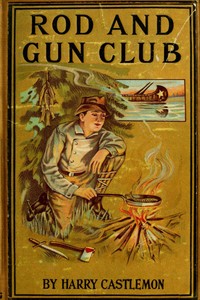
The Rod and Gun Club — Text and Context
(0 User reviews)
3199
Project Gutenberg
2019
Not confirmed
Conduct of life -- Juvenile fiction; Children -- Conduct of life -- Juvenile fiction; Friendship -- Juvenile fiction; Fathers and sons -- Juvenile fiction; Runaway children -- Juvenile fiction; Students -- Juvenile fiction; Hunting -- Juvenile fiction; Military education -- Juvenile fiction; Firearms -- Juvenile fiction
Readers of public-domain and historical texts
Project Gutenberg digital edition
en
Edition facts
Words
80,267
Reading time
349 min
Text sections
7
This digital edition of The Rod and Gun Club — Text and Context is described by source-level measurements including 80,267 words, 5 hr 49 min estimated reading time, and 7 detected text sections.
The text analysis averages about 19.9 words per sentence, while the detected sections provide another way to judge how the source is divided.
Project Gutenberg metadata also associates the work with “Conduct of life -- Juvenile fiction,” connecting these edition facts with the source record’s subject description.
Source:
Project Gutenberg record #60838
An editorial note examining Harry Castlemon's diction, dialogue, and descriptive choices in The Rod and Gun Club, focusing on how the author constructs authority, fear, and action through specific verbal patterns and narrative framing.
Read the complete public-domain text at its original source.
Read on Project GutenbergHarry Castlemon opens The Rod and Gun Club with a father’s blunt declaration: “I have got you provided for, for four long years to come.” The line, delivered by Mr. Brigham to his son Lester, establishes a pattern of adult authority expressed through clipped, declarative sentences. Castlemon’s dialogue often carries the weight of command or judgment, with characters speaking in short, emphatic phrases that leave little room for reply. The narrative voice, meanwhile, favors concrete action over interior reflection, describing what characters do rather than what they feel. This editorial note examines three authorial choices visible in the excerpts: the use of dialogue to convey power dynamics, the reliance on physical detail to depict violence, and the structuring of scenes around moments of decision or confrontation.
Dialogue as a Tool of Authority
Castlemon’s dialogue frequently serves to establish hierarchy. Mr. Brigham’s opening speech is a monologue of control: he places his hat and gloves on the table, looks down at his son, and delivers his verdict. The boy, Lester, sits “on the edge of the sofa, twirling his cap in his hands”—a posture of submission reinforced by the father’s physical dominance. Later, during the riot scene, a lieutenant barks commands: “Get up and go to work. Where’s your gun?” The question is not a request but an order, and the soldier’s response—“Gordon’s got it”—is a confession of failure. Castlemon rarely uses indirect speech for authority figures; their words are direct, often imperative, and leave no ambiguity. This stylistic choice mirrors the rigid social structures of the military academy setting, where obedience is expected and deviation is punished.
Descriptive Economy in Action Scenes
Castlemon describes violence with a reporter’s brevity. When a student is shot, the narrative records: “I’ve got it,” said he, as Don sprang to his assistance. The wound is not lingered upon; the focus shifts immediately to Don’s response. Later, a bullet strikes a boy’s breast-plate, making “an ugly wound in his chest,” but the description stops there—no blood, no pain, no aftermath. Castlemon’s action sequences are built from short, declarative sentences: “Don opened the door,” “the company was called to attention,” “they left the car on a run.” The effect is cinematic, prioritizing movement over sensation. This economy extends to the mob’s threat: they promise to “wipe the last one of ’em out,” but the volley that scatters them is described in a single clause. Castlemon trusts the reader to fill in the horror, focusing instead on the mechanics of the fight.
Recurring Motifs of Fear and Bravery
Fear in Castlemon’s world is often expressed through physical stillness or concealment. One student lies “prone under a seat,” refusing to fight; another bends double and clasps his leg after being shot. Don, by contrast, is defined by movement: he springs to assist, returns to the track, takes possession of a fallen comrade’s gun. The narrative rewards this activity—Don survives a near-miss because he is out of line. Castlemon uses the motif of the “marksman’s badge” to signal competence; Egan and Curtis, who have won it, fire “as fast as they could load,” and their shots are not wasted. The badge becomes a shorthand for skill and courage. The author’s diction reinforces this binary: students are either “steady as veterans” or hiding under seats. There is little middle ground, and the text’s moral clarity is reflected in its vocabulary of action and inaction.
Narrative Framing and the Reader’s Role
Castlemon’s narrator rarely editorializes, but the framing of scenes guides interpretation. The chapter title “Some Disgusted Boys” primes the reader to expect dissatisfaction, and the opening dialogue confirms it. Later, when Don finds a gun on the floor and uses it, the narrator notes that the weapon’s owner “had showed no disposition to use it when he had it.” The comment is a quiet judgment, reinforcing the value of initiative. Castlemon also uses the wounded boy’s breast-plate as a narrative device: the detail that the bullet would have hit Don “squarely in the side” if he had been in line creates a sense of fate or luck. The author does not explain this—he simply presents the fact, leaving the reader to infer the stakes. This restraint is characteristic of Castlemon’s style, which trusts action and dialogue to carry meaning without authorial intrusion.
Readers approaching The Rod and Gun Club will find a story driven by external conflict and clear moral contrasts. Castlemon’s prose rewards attention to what characters say and do rather than what they think. The excerpts suggest a world where authority is voiced in commands, bravery is demonstrated through movement, and fear is shown in stillness. The author’s choices in diction and description create a fast-paced, visually immediate narrative that prioritizes action over introspection. This edition invites readers to observe how Castlemon builds tension through dialogue and physical detail, and to consider how these techniques shape the story’s portrayal of boyhood, duty, and danger.
I’ve often thought that Castlemon’s boys, with their rigid authority and fearful respect for the wild, share a quiet kinship with the girls in the snow—both learn that safety lies in steady voices. There’s a particular warmth in The Camp Fire Girls Amid the Snows — Edition Insights, a gentler echo of that same careful watchfulness. Two different camps, one patient truth.
There are no reviews for this eBook.
There are no comments for this eBook.
Reader reflection
Take a moment to reflect on this book
Create a short personal record of your experience with this book.
Your progress
0
/
10
2
Did this book hold your interest?
3
How likely are you to recommend this book?
4
Did the language feel accessible?
5
Could you apply anything you learned?
6
How closely did the book connect with your experience?
7
How would you rate its originality?
8
How well did it match your expectations?
9
What is the main idea you are taking away?
10