1

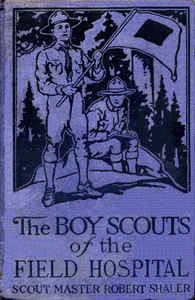
The Boy Scouts of the Field Hospital — Background and Themes
(0 User reviews)
184
Project Gutenberg
2015
Not confirmed
Strikes and lockouts -- Juvenile fiction; Mystery and detective stories; Boy Scouts of America -- Juvenile fiction; First aid in illness and injury -- Juvenile fiction; Military hospitals -- Juvenile fiction
Readers of public-domain and historical texts
Project Gutenberg digital edition
en
Edition facts
Words
33,047
Reading time
144 min
Text sections
5
The source record for The Boy Scouts of the Field Hospital — Background and Themes measures this digital text at 33,047 words, 2 hr 24 min estimated reading time, and 5 detected text sections.
The text analysis averages about 21.2 words per sentence, while the detected sections provide another way to judge how the source is divided.
Project Gutenberg metadata also associates the work with “Strikes and lockouts -- Juvenile fiction,” connecting these edition facts with the source record’s subject description.
Source:
Project Gutenberg record #49676
In this Boy Scouts adventure, assistant scout master Hugh leads his troop into a strike-torn area to set up a field hospital. The narrative contrasts scout discipline with mob violence, focusing on first aid, moral dilemmas, and the tension between duty and safety.
Read the complete public-domain text at its original source.
Read on Project GutenbergThe story opens with a conversation between scouts Hugh and Billy, who lament that their scout master, Lieutenant Denmead, has been called away due to his mother's illness. This personal crisis immediately establishes a pattern of duty conflicting with personal life, a tension that recurs throughout the narrative. Hugh, as assistant scout master, is left in charge, and the weight of responsibility is palpable in his dialogue: he admits he will 'try my level best to please you, but if I succeed it will only be because I've got' the support of the troop. The setting—a camp on the Hurricane—suggests both a natural location and a brewing storm of events.
The excerpts reveal a story that pivots on a strike at a cement works, where violence erupts and wounded men are left unattended. The scouts must decide whether to intervene, balancing humanitarian impulses against the risks of entering 'disputed territory now given over to anarchy and bloodshed.'
The Weight of Command
Hugh's internal conflict is a central thread. He feels 'the responsibility weighed heavily on him,' and his decision-making process is marked by a careful, almost procedural approach. When faced with the call to aid the wounded, he does not act alone but turns to a democratic vote among the scouts, saying, 'I can't find the answer to this thing by myself, fellows, and I want you to decide it for me.' This moment highlights the troop's collective ethos and Hugh's reluctance to impose his will, even as he secretly hopes for a specific outcome. The narrative emphasizes that leadership here is not about issuing orders but about sharing burdens.
The text also shows Hugh's awareness of his limitations: he selects only five scouts to accompany him, choosing those with 'the necessary nerve' and skill, explicitly excluding those 'afflicted with weak nerves' or 'clumsy by nature.' This practical assessment of capability grounds the adventure in realistic scout principles.
First Aid as Moral Imperative
The excerpts repeatedly link scout training with ethical action. Arthur Cameron, who has a 'fascination' with first aid and dreams of becoming a surgeon, is the catalyst for the rescue mission. His plea—'think of those who must have been shot down... there the poor chaps must lie, bleeding to death'—frames medical knowledge as a moral duty. The narrative contrasts the scouts' disciplined response with the chaos of the strike: the guards 'won the scrap,' while the strikers are described as a 'mob' that 'scattered like sheep.'
Hugh's vision of 'poor fellows lying there in danger of bleeding to death' gives him 'a cold feeling in the region of his heart,' a visceral reaction that drives him to act. The story thus positions first aid not merely as a skill but as a humane obligation that overrides personal safety.
Strike Violence and Scout Neutrality
The strike setting introduces a volatile backdrop. The cement works are surrounded by a stockade, and the fighting is described as 'short and swift,' with a 'last volley' that disperses the crowd. The scouts must navigate this conflict without taking sides. Their mission is purely humanitarian: to aid the wounded regardless of allegiance. The text notes that 'the men in the works will be afraid to come out,' leaving the injured abandoned. This creates a vacuum that the scouts fill, positioning them as neutral helpers in a polarized environment.
The narrative also hints at the broader social tensions of the era—strikes, strike-breakers, and mob violence—but keeps the focus on the scouts' response. Their decision to advance 'in the direction of the disputed territory' is a deliberate step into danger, underscoring the theme of courageous service.
Readers should note that the excerpts cover only the early chapters, ending as the scouts prepare to move toward the strike zone. The full story likely follows their efforts to establish a field hospital and treat the wounded, with potential complications from both the strikers and the authorities. The narrative's strength lies in its detailed depiction of scout procedures and the ethical dilemmas of leadership under pressure. Pay attention to how Hugh's decisions reflect the scout law and how the troop's unity is tested by external conflict.
Reading about Hugh weighing duty against danger in that strike-torn town, I remembered a summer I spent bandaging scraped knees at a camp, wondering if order ever truly holds. Cupid of Campion once gave me that same quiet ache—how small kindnesses try to patch what bigger forces tear open. Something about rescue, and why we bother. Cupid of Campion — Edition Insights lingers in that same tender place, without saying so directly.
There are no reviews for this eBook.
There are no comments for this eBook.
Reader reflection
How will you remember this book?
Save your reaction, strongest insight, and memorable passage.
Your progress
0
/
10
2
How much did you enjoy the reading experience?
3
Would you pass this book on to a friend?
4
What was the reading difficulty like?
5
How personally connected did you feel to the book?
6
How well did it match your expectations?
7
What was the strongest part of the book?
8
Could you apply anything you learned?
9
What did this book teach you most?
10