1

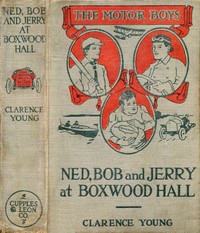
Ned, Bob and Jerry at Boxwood Hall; Or, The Motor Boys as Freshmen — Themes and Context
(0 User reviews)
112
Project Gutenberg
2016
Not confirmed
Schools -- Juvenile fiction; College students -- Juvenile fiction; Automobiles -- Juvenile fiction; Baseball stories; Teamwork (Sports) -- Juvenile fiction; Sportsmanship -- Juvenile fiction
Readers of public-domain and historical texts
Project Gutenberg digital edition
en
Edition facts
Words
58,147
Reading time
253 min
Text sections
32
The source record for Ned, Bob and Jerry at Boxwood Hall; Or, The Motor Boys as Freshmen — Themes and Context measures this digital text at 58,147 words, 4 hr 13 min estimated reading time, and 32 detected text sections.
The text analysis averages about 12.7 words per sentence, while the detected sections provide another way to judge how the source is divided.
Project Gutenberg metadata also associates the work with “Schools -- Juvenile fiction,” connecting these edition facts with the source record’s subject description.
Source:
Project Gutenberg record #51079
This editorial note examines Clarence Young's diction, dialogue, and descriptive choices in the opening chapters of the Motor Boys' freshman year at Boxwood Hall, focusing on how the author constructs the trio's camaraderie, the proctor's authority, and the illicit midnight feast scene.
Read the complete public-domain text at its original source.
Read on Project GutenbergFrom the opening line—"AS BOB CROSSED HOME PLATE WITH HIS RUN, JERRY WAS NOT FAR BEHIND HIM"—Clarence Young plunges readers into action, establishing the Motor Boys' athletic prowess and tight bond. The narrative voice is brisk and colloquial, favoring direct speech over introspection. Dialogue carries much of the characterization: Bob's nickname "Chunky" and his eager suggestion to "have feeds in their rooms" reveal a genial, rule-bending nature, while Jerry's pragmatic agreement and Ned's quick assent show a united front. Young's descriptions are functional, often summarizing events ("There is no need to describe what took place") rather than lingering on sensory detail, which keeps the pace brisk but sacrifices texture.
Diction and the Boys' Vernacular
Young equips the Motor Boys with a period-appropriate slang that signals their youthful energy and group identity. Phrases like "all to the mustard" (meaning excellent) and "caught with the goods" pepper their exchanges, creating an insiders' code. The narrator adopts a similar register, using colloquialisms such as "grub" for food and "tough luck" for misfortune. This linguistic consistency blurs the line between narration and character voice, immersing the reader in the boys' world. Notably, the proctor, Mr. Thornton, speaks in a more formal, clipped manner—"You will kindly give me your names"—which sets him apart as an authority figure. The contrast is sharp: the boys' language is fluid and familiar; the proctor's is stiff and disciplinary. Young thus uses diction to map social boundaries within the school.
Dialogue as a Driver of Plot and Character
Young relies heavily on dialogue to advance the story and define relationships. In the feast-planning scene, the boys' rapid-fire exchanges—"Then let's do it," "Go as far as you like, Chunky," "And we'll ask some of the crowd in"—convey their enthusiasm and collective decision-making. The proctor's interruption is marked by a single line of dialogue: "Well, young gentlemen, you seem to be having a good time." The ironic politeness of "young gentlemen" underscores his authority and the boys' transgression. After the raid, Jerry's question "Well, what do you think of that?" and Ned's sarcastic reply "Mighty little" reveal their frustration without lengthy exposition. Young trusts dialogue to carry emotion, often letting a terse exchange stand in for paragraphs of internal monologue.
Descriptive Economy and the Midnight Feast
Young's descriptions of the midnight feast are notably sparse. He lists items—"sandwiches galore, pies, cake, bottles of olives and various tinned dainties"—in a rapid inventory that prioritizes quantity over sensory appeal. The setting is sketched with minimal detail: keyholes stuffed with paper, darkened windows. The proctor's entrance is described with stark efficiency: "A key grated in the lock, the door was suddenly thrown open." The result is a scene that feels more like a stage direction than a fully realized environment. This economy of description keeps the focus on action and consequence, but it also means that the physical world of Boxwood Hall remains vague. Readers learn little about the rooms' layout or atmosphere beyond what is necessary for the plot.
Narrative Voice and the Author's Intrusion
Young occasionally steps back from the action to address the reader directly, as in the aside: "If a boy has never taken part in one he has imagined them." This intrusion assumes a shared experience between narrator and audience, reinforcing the book's intended readership. The narrator also editorializes with phrases like "Ingloriously the guests slunk away," which injects a mild judgment. Such moments break the fourth wall and remind readers that they are being told a story with a moral framework. However, Young does not moralize heavily; the boys' punishment is presented as a natural consequence rather than a lesson. The narrative voice remains consistently light and conversational, even when describing the trio's "chagrin" and "astonishment."
Readers attentive to Young's authorial choices will notice how diction, dialogue, and description work together to create a fast-paced, character-driven narrative. The Motor Boys speak and act in ways that reflect their era and their station, while the narrator's occasional asides invite a conspiratorial bond with the audience. For those interested in early twentieth-century boys' series fiction, this volume offers a clear example of how formulaic elements—sports, school, mischief—are animated by a consistent and purposeful voice.
Reading about the midnight feast at Boxwood Hall, I remembered sneaking crackers under my own bedcovers, that same thrilling mix of crumbs and conspiracy. Ned, Bob and Jerry capture that defiance so precisely it feels familiar. Another book once gave me that identical warmth, that hush of shared secrets: Mr. Blake's Walking-Stick: A Christmas Story for Boys and Girls — Key Ideas to Explore. Both simply remember how a little rule-breaking makes friendship feel truer.
There are no reviews for this eBook.
There are no comments for this eBook.
Reader reflection
How did this book work for you?
Your answers remain private and are stored only in this browser.
Your progress
0
/
10
2
How much did you enjoy the reading experience?
3
Would you recommend this book to another reader?
4
How easy was the book to follow?
5
Would you like to discuss this book with someone?
6
How did the pace of the book feel?
7
Do you expect to return to this book?
8
Did any part of the book stay with you emotionally?
9
In one sentence, what did you learn?
10