1

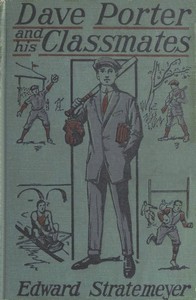
Dave Porter and His Classmates; Or, For the Honor of Oak Hall — Edition Insights
(0 User reviews)
180
Project Gutenberg
2016
Not confirmed
Schools -- Juvenile fiction; Friendship -- Juvenile fiction; Boarding schools -- Juvenile fiction; Sports stories; Teamwork (Sports) -- Juvenile fiction; Sportsmanship -- Juvenile fiction
Readers of public-domain and historical texts
Project Gutenberg digital edition
en
Edition facts
Words
68,768
Reading time
299 min
Text sections
34
The catalog record for Dave Porter and His Classmates; Or, For the Honor of Oak Hall — Edition Insights provides practical reading context through 68,768 words, 4 hr 59 min estimated reading time, and 34 detected text sections.
The text analysis averages about 13.1 words per sentence, while the detected sections provide another way to judge how the source is divided.
Project Gutenberg metadata also associates the work with “Schools -- Juvenile fiction,” connecting these edition facts with the source record’s subject description.
Source:
Project Gutenberg record #53414
This editorial note examines how Edward Stratemeyer structures Dave Porter and His Classmates through recurring images of movement, balance, and transition, using excerpts to trace patterns in scene shifts, problem-solving, and the interplay between physical and social spaces at Oak Hall.
Read the complete public-domain text at its original source.
Read on Project GutenbergEdward Stratemeyer's Dave Porter and His Classmates (1909) moves its characters through a series of carefully staged transitions: from dormitory to hallway, from classroom to rooftop, from social inclusion to ostracism. The excerpts reveal a narrative that relies on physical movement—gliding forms, climbing ladders, balancing planks—to dramatize both literal and figurative shifts in standing. This note focuses on three structural and imagistic patterns visible in the text: the use of balance as a problem-solving motif, the recurrence of nocturnal movement across thresholds, and the way social hierarchies are enforced through spatial exclusion.
Balance as a Structural Motif
The excerpts contain a notable anecdote about a lumberman who solves a mathematical problem by balancing a plank on a stick. This image of physical equilibrium recurs throughout the narrative, not merely as a joke but as a model for how characters navigate challenges. Dave and his friends repeatedly face situations that require them to find a point of balance—between loyalty and justice, between pranks and discipline, between individual action and group consensus. The lumberman's method, cutting where the plank balances, mirrors the boys' own approach to conflicts: they seek pragmatic, often physical solutions rather than abstract reasoning. This motif extends to the structure of scenes, which frequently pivot on a moment of equilibrium before tipping into action.
Nocturnal Threshold Crossings
Two excerpts describe a midnight sequence in which Dave wakes to find a form brushing his face, then follows a white-clad figure through a dark hallway, up a back stairs, and toward an open scuttle on the roof. The scene is built around a series of threshold crossings: from sleep to wakefulness, from dormitory to hallway, from interior to exterior. The open scuttle admits wind and rain, blurring the boundary between inside and outside. This pattern of nocturnal movement—stealthy, curious, often involving a pursuit—appears to be a recurring structural device, used to shift the setting from the regulated school day to a more ambiguous nighttime space where rules are suspended and discoveries occur.
Social Exclusion Through Spatial Distance
The Gee Eyes club votes to give Link Merwell and Nat Poole "the cold shoulder," a social sanction enforced by spatial isolation: members are to ignore them "as though they did not exist" outside of required school sessions. The narrative literalizes this exclusion by having the two boys keep out of reach, moving through the school's spaces as fugitives. Dave correctly predicts that this will make Merwell more savage, not repentant. The structure of the story thus uses physical distance—avoidance, hiding, being left alone—to map social hierarchies. The school itself becomes a grid of inclusion and exclusion, with corridors and rooms serving as zones of belonging or banishment.
Scene Changes and the Rhythm of Transition
Stratemeyer moves between scenes with a consistent rhythm: a problem or tension is introduced, then resolved or suspended by a shift in location or activity. The excerpts show this pattern clearly: after the initiation dispute, the narrative cuts to academic tests, then to a desire for skating, then to rain and sleep, then to the midnight prowler. Each transition is marked by a change in weather, time of day, or physical setting. The rain that ends the skating possibility also sets the stage for the nocturnal scene. This technique keeps the story in motion, but it also means that emotional or moral consequences are often deferred or displaced onto the next episode. The reader is carried along by the momentum of place changes rather than by sustained psychological development.
Readers attentive to these patterns will notice how Stratemeyer uses physical movement—balancing, climbing, avoiding, following—to dramatize the social and moral negotiations of school life. The open scuttle, the balanced plank, the cold shoulder: each is a concrete image for an abstract process. The narrative's strength lies not in deep characterization but in its choreography of bodies through space, making the school itself a character that shapes every encounter.
I’ve often thought that Dave Porter and His Classmates breathes like a boy learning to stop mid-stride—each chapter a caught breath before he steps forward again. That same gentle pause lives on in another school tale, Cupid of Campion — Edition Insights, where young hearts sway between mischief and quiet longing. Both know how boys grow not by rushing, but by balancing. A lovely, unspoken kinship.
There are no reviews for this eBook.
There are no comments for this eBook.
Reader reflection
What was your reading experience?
Capture what you thought, learned, and would like to remember.
Your progress
0
/
10
2
How did the book work for you overall?
3
Would you recommend this book to another reader?
4
What was the reading difficulty like?
5
Did the book offer a fresh perspective?
6
How understandable was the text?
7
Which element worked best for you?
8
Did the book meet your expectations?
9
What did this book teach you most?
10