1

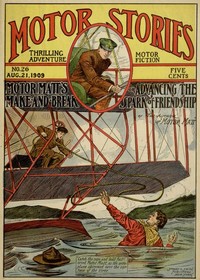
Motor Matt's Make-and-Break; or, Advancing the Spark of Friendship — Inside the Classic
(0 User reviews)
382
Project Gutenberg
2016
Not confirmed
Adventure stories; Dime novels; Cowboys -- Juvenile fiction; Airplanes -- Juvenile fiction; Mechanics -- Juvenile fiction
Readers of public-domain and historical texts
Project Gutenberg digital edition
en
Edition facts
Words
35,698
Reading time
156 min
Text sections
4
For Motor Matt's Make-and-Break; or, Advancing the Spark of Friendship — Inside the Classic, the stored edition analysis reports 35,698 words, 2 hr 36 min estimated reading time, and 4 detected text sections.
The text analysis averages about 14.6 words per sentence, while the detected sections provide another way to judge how the source is divided.
Project Gutenberg metadata also associates the work with “Adventure stories,” connecting these edition facts with the source record’s subject description.
Source:
Project Gutenberg record #52025
In this 1909 dime novel, Motor Matt uses mechanical know-how and quick thinking to outmaneuver a broker and a cowboy gang. The narrative shifts between tense standoffs and technical problem-solving, with dialogue revealing character through clipped exchanges.
Read the complete public-domain text at its original source.
Read on Project GutenbergFrom its first chapter, Motor Matt's Make-and-Break announces itself as a story built on mechanical metaphors and moral dilemmas. The title phrase, borrowed from early ignition systems, signals both a technical interest and a thematic concern with repairing relationships. The narrative voice moves briskly between action sequences and conversational exchanges, often letting dialogue carry the burden of plot advancement. Matt King, the hero, is introduced not through description but through his effect on others—a broker's clerk calls him "the king of the motor boys" before we see him act.
Dialogue as Engine
The story's pace is largely driven by its dialogue, which alternates between clipped commands and longer, explanatory speeches. In the opening chapter, a postman drops a letter with no more than "There's a letter for him," and the scene moves forward without narrative commentary. Later, when Matt is captured, his captors argue in short, tense lines: "Don't make a fool of yourself, Newt," and "He saved my life." These exchanges reveal character through rhythm rather than description—Murgatroyd's sentences are sharp and imperative, while Newt's are defensive and halting. The author rarely uses adverbs to qualify speech; instead, the emotional weight is carried by the words themselves and the actions that interrupt them, such as pouring a drink or adjusting ropes.
The Skeleton and the Spark
Two recurring images structure the narrative: the "skeleton in the closet" and the "spark of friendship." The first appears in the chapter title and is literalized when Prebbles resurrects a hidden secret. The second, drawn from ignition technology, is used to describe Matt's efforts to reform a wayward youth. These metaphors are not decorative but functional: they give the reader a framework for understanding the story's moral arithmetic. The skeleton represents past debts and hidden crimes; the spark represents the possibility of redemption through mechanical or human intervention. The narrative treats both with the same matter-of-factness, as if repairing a reputation were no different from fixing a motor.
Pace and the Interruption
The story's rhythm depends on sudden interruptions that shift the scene or the balance of power. A letter arrives; a shot is fired across the bows; a cowboy appears in a doorway. These moments are often signaled by a single line of dialogue or a brief narrative statement, such as "A lighted bomb, hurled suddenly into the shack, could not have startled either of the two men more." The author uses these interruptions to break up longer passages of exposition or negotiation, keeping the reader off balance. The effect is that of a series of small explosions, each advancing the plot while also revealing character under pressure. Matt's calmness in these moments—his ability to think mechanically while others panic—becomes his defining trait.
Readers interested in the mechanics of dime-novel plotting will find Motor Matt's Make-and-Break a compact example of how serial fiction managed pace and character through dialogue and interruption. The story rewards attention to its technical language—the title's "make-and-break" is both a literal ignition system and a description of the plot's alternating tensions. Approach it as a period artifact that uses its genre conventions with precision.
The rain drummed on the sill that afternoon while Motor Matt’s careful tinkering—that quiet, patient fixing of what was broken—felt less like adventure and more like friendship. Later, idly, I picked up another old story, and found the same warmth in its cluttered porch scenes and whispered plans. It was called Dorothy Dale and Her Chums — Context and Discussion. The spark just carried over.
There are no reviews for this eBook.
There are no comments for this eBook.
Reader reflection
What was your reading experience?
Capture what you thought, learned, and would like to remember.
Your progress
0
/
10
2
Did this book hold your interest?
3
Would you recommend this book to another reader?
4
What was the reading difficulty like?
5
Did it raise ideas you would like to talk about?
6
How strongly did the book affect you emotionally?
7
How original did the book feel?
8
Which part made the strongest impression?
9
Which lesson or insight stayed with you?
10