
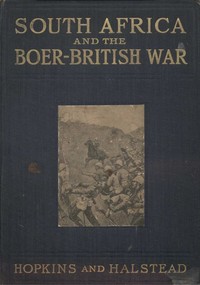
South Africa and the Boer-British War, Volume I by Hopkins and Halstead
Published in 1900, this first volume is a piece of history written in the heat of the moment. It's not a dry, distant look back. It's a contemporary account of the events leading up to the Boer War, compiled by American journalists J. Castell Hopkins and Murat Halstead. They were trying to make sense of a conflict that had the whole world watching.
The Story
The book doesn't have a single plot in the fiction sense. Instead, it traces the long, tangled roots of the war. It starts by introducing the key players: the Boers, descendants of Dutch settlers who created their own republics (the Transvaal and Orange Free State), and the British Empire, which was expanding its influence across southern Africa. The discovery of massive gold deposits in the Transvaal in 1886 is the spark. Suddenly, the Boer republic is flooded with foreign miners (called 'Uitlanders'), British money, and imperial ambition. The book shows how political rights, economic control, and failed negotiations created a powder keg. It builds the case, using sources from the time, to explain why diplomacy broke down and why both sides felt war was inevitable by 1899.
Why You Should Read It
What grabbed me was the perspective. This isn't a British or a Boer account; it's an American one from over a century ago. The authors act like reporters on a huge, complex beat. They present speeches, treaty texts, and arguments from both sides. You get to see the propaganda, the fears, and the justifications in their original form. It lets you feel the complexity of the situation—there are clear injustices and also stubborn national pride on all sides. Reading it, you understand this wasn't just a small colonial war. It was a clash of cultures, economies, and political ideals that would define South Africa for the next century.
Final Verdict
This is a fantastic read for anyone who loves primary sources and wants to get beyond textbook summaries. It's perfect for history buffs who enjoy seeing how events were understood as they happened, warts and all. Because it's from 1900, the language and some viewpoints are dated, but that's part of its charm and value. It’s not a light, narrative history; it demands a bit more attention. But if you stick with it, you're rewarded with a front-row seat to the making of a monumental conflict. Think of it as the ultimate deep-dive documentary, in book form.
This title is part of the public domain archive. Share knowledge freely with the world.
Richard Hernandez
5 months agoGood quality content.
John Anderson
3 months agoI have to admit, the emotional weight of the story is balanced perfectly. I would gladly recommend this title.
Christopher Sanchez
1 year agoI have to admit, the plot twists are genuinely surprising. I will read more from this author.
Kenneth Torres
1 year agoAfter finishing this book, the storytelling feels authentic and emotionally grounded. I learned so much from this.



Donna Hernandez
3 months agoVery interesting perspective.