
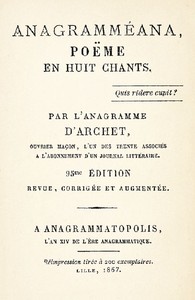
Anagramméana, poëme en huit chants by G. A. J. Hécart
Let's be clear from the start: 'Anagramméana, poëme en huit chants' is not your typical epic poem. You won't find sweeping battles or tragic romances here. Instead, you find a linguistic experiment on a grand scale. Written in the early 19th century by Gabriel Antoine Joseph Hécart, the entire work is structured around anagrams—rearranging the letters of words or phrases to form new ones.
The Story
There isn't a conventional narrative in the way we think of stories today. The "eight chants" (or songs) are less about a linear plot and more about exploring themes, ideas, and descriptions through this constrained form. Hécart takes subjects—perhaps historical figures, philosophical concepts, or moral lessons—and then twists and turns their names and associated words into new configurations. The 'story' is the unfolding of these puzzles. It's a demonstration of control and creativity, showing what can be said when you force language to bend to a specific, playful rule.
Why You Should Read It
This book is a curiosity cabinet for word lovers. It's less about what it says and more about how it says it. Flipping through it, you get a real sense of Hécart's personality—this was clearly a man who found deep joy and intellectual satisfaction in the mechanics of language. In an age of algorithms, reading something crafted with such meticulous, human cleverness is refreshing. It makes you look at words differently, seeing them as building blocks that can be endlessly reconfigured.
Final Verdict
This is a niche book, but a brilliant one for the right reader. It's perfect for logophiles, puzzle enthusiasts, and anyone interested in the history of playful literature. If you enjoy crosswords, Scrabble, or cryptic codes, you'll appreciate Hécart's monumental effort. It's not a book you race through; it's one to dip into, to marvel at, and to share the most mind-bending anagrams you find with friends. Think of it less as a novel and more as an artifact from a time when intellectual games were an art form.
No rights are reserved for this publication. You are welcome to share this with anyone.
Emily Hill
1 year agoSurprisingly enough, the arguments are well-supported by credible references. I learned so much from this.
Linda Moore
1 year agoVery helpful, thanks.
Emma King
11 months agoEnjoyed every page.
Mark Sanchez
9 months agoFrom the very first page, the narrative structure is incredibly compelling. Thanks for sharing this review.